9th May 2026 Blaafarveværket 250th Anniversary
Blaafarveværket was founded in 1776 following Ole Witloch’s discovery of cobalt ore in Skuterudåsen in 1772.
At the time, cobalt was highly valuable, and the site was established to produce cobalt blue pigment, used in porcelain, glass, and paper. By the 18th century, exports reached China and Japan. It became a miniature society with its own schools and welfare schemes.
Blaafarveværket was a pioneer in social rights, offering medical care, sickness funds, pensions and free housing, lighting and heating. The workers’ movement gained early traction here, inspired by Marcus Thrane. In 1822, German businessmen Benecke and Wegner took over, modernising operations.
During the 1830s and 1840s, Blaafarveværket became Norway’s largest mining enterprise and the world’s leading producer of cobalt blue, covering 80% of the global market with over 1,200 employees. Decline began in 1846 due to competition from synthetic ultramarine and a European economic crisis, and the company went bankrupt in 1849. Although new cobalt deposits were found in the 1870s, they proved unstable, and mining ceased in 1898.
After years of decay, Tone and Kjell Steinsvik initiated preservation efforts in 1968. The Modum Blaafarveværk Foundation was established, transforming the site into a museum and art centre. Today, it is one of Norway’s most visited museums, renowned for its exhibitions, mine tours, and scenic surroundings, and has applied for UNESCO World Heritage status.
Facts
-
- NK 2165 BLAAFARVEVÆRKET 250TH ANNIVERSARY
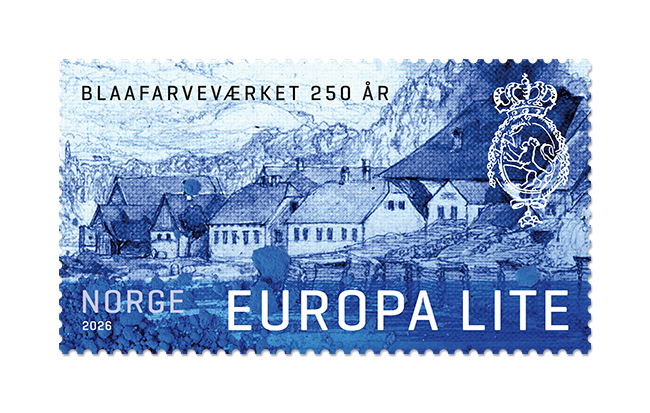
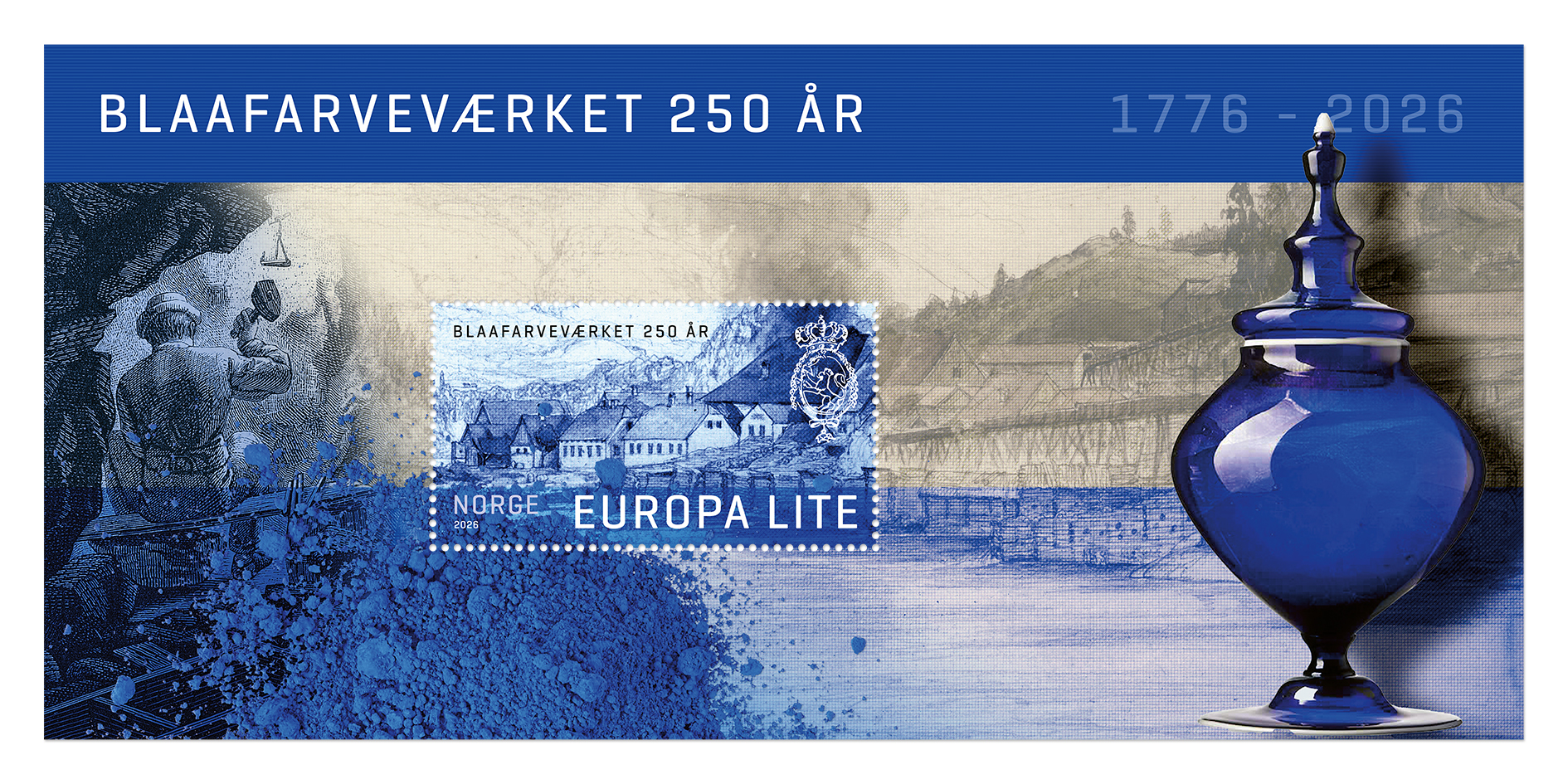
- Value and subject: Europe small: Blaafarveværket, watercolour by Thomas Fearnley (1840). Miniature sheet: Miner, cobalt powder and a cobalt‑blue jar from Gjøvik Glassverk (ca. 1820)
- Design: Enzo Finger
- Photos: Blaafarveværket, Linden Lab
- Size: 45 x 25 mm (stamp), 150 x 70 mm (miniature sheet)
- Issued in: Booklet of 10 stamps, miniature sheet and prestige booklet
- Print: Offset from Joh. Enschedé Security Print
- Print run: 545,000 stamps, 35,000 miniature sheets, 2,000 prestige booklets